Publications
2026
- Multiaxial Finite Strain Behavior of Polydomain Liquid Crystal ElastomersApplied Mathematics and Mechanics - Under Review, 2026
Liquid Crystal Elastomers (LCEs) represent a class of stimuli-responsive polymers that combine the order-dependent properties of liquid crystal mesogens with the soft elasticity of polymer networks. Apart from some benchmark loading scenarios such as uniaxial loading tests, the literature lacks a theoretical framework addressing the response of LCEs under complex, multiaxial loading. For this purpose, this study investigates the stress response of polydomain LCE cylinders and balloons under loading cases including pure extension–torsion, inflation, and extension–torsion–inflation. To do so, a robust analytical framework was developed by assuming polydomain LCEs to be isotropic hyperelastic materials in order to alleviate the need for step-length tensors and anisotropy parameters in purely mechanical loadings. The analytical framework was validated using finite element method (FEM) results, revealing excellent agreement between predictions. To assess the stress response of the hyperelastic LCEs considered, the analytical framework employed three different forms of the strain energy function, namely Mooney–Rivlin, Yeoh, and Anssari-Benam. Among them, the Yeoh and Anssari-Benam models were capable of capturing inherent strain-softening and large-deformation effects in LCEs across a wide range of stretch values. This study also shows that strain energy functions of binomial form, such as Anssari-Benam, provide the most accurate predictions for all stress components. As practical considerations, the study derived the blocking force and the resultant longitudinal torque responses of polydomain LCEs, and illustrated the through-thickness instability phenomenon occurring in LCE balloons with respect to different geometric factors. These results offer a straightforward pathway for the analysis and design of polydomain LCEs that are mainly deployed as soft actuators and peristaltic pumps.
@article{SAFAEI2025105540, title = {Multiaxial Finite Strain Behavior of Polydomain Liquid Crystal Elastomers}, journal = {Applied Mathematics and Mechanics - Under Review}, year = {2026}, doi = {10.21203/rs.3.rs-9517724/v1}, url = {https://www.researchsquare.com/article/rs-9517724/v1}, author = {Safaei, Mohammad Ali and Baghani, Mostafa and Baniassadi, Majid and Askari-Sedeh, Mahdi}, publisher = {ResearchSquare}, dimensions = {true}, keywords = {Polydomain Liquid Crystal Elastomers, Thick-walled Structures, Large Deformations, Multiaxial Loading, Soft Actuators} } -
 Toward Responsive Polymer Actuators Based on Novel Composite StructuresSmart Polymers for Sensing Technologies, 2026
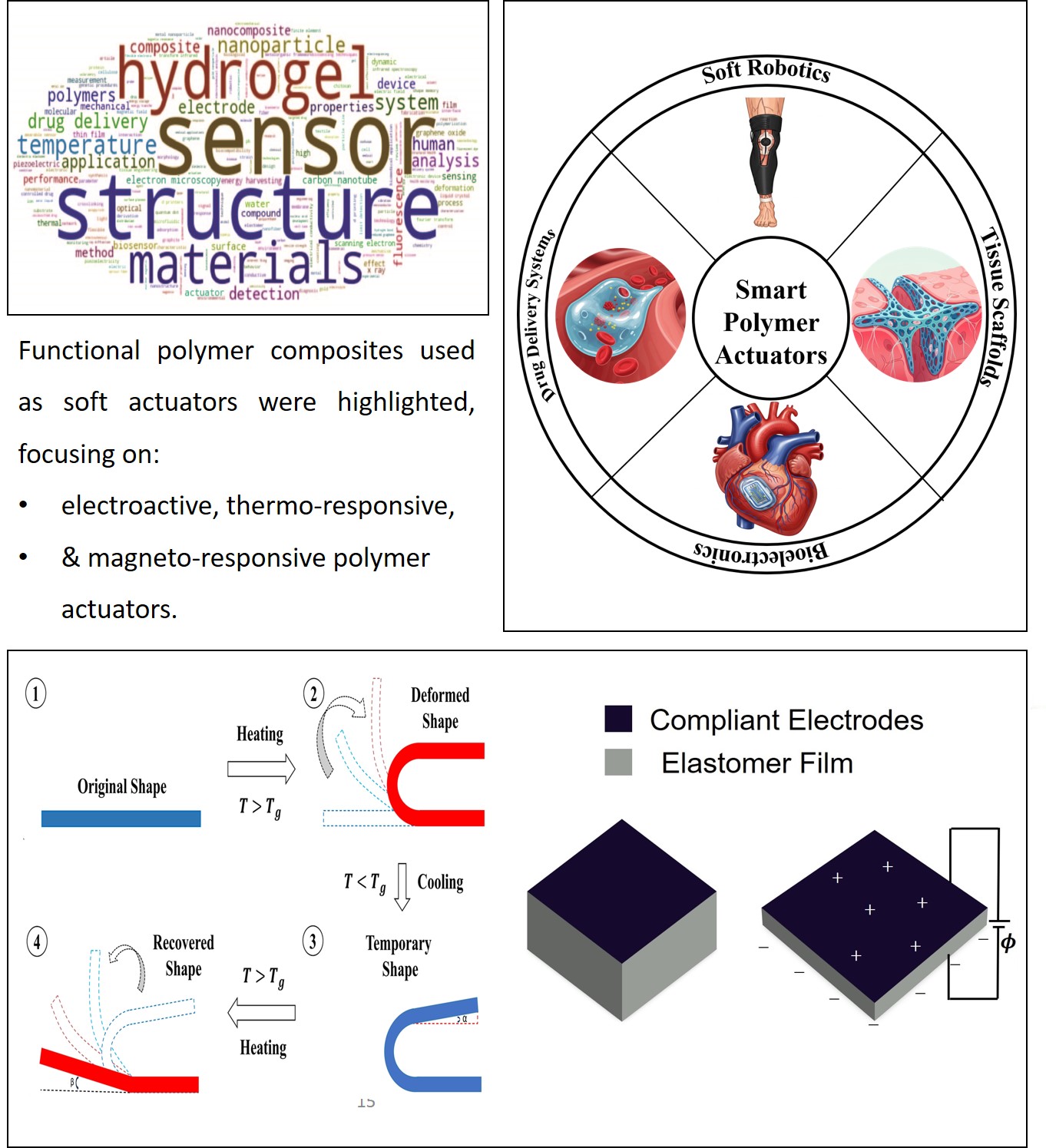
Recent advancements in materials science have highlighted the growing demand for materials with complex properties, such as flexibility, biodegradability, and multifunctionality, driving the development of smart materials. These materials are typically functional polymers that respond to various external stimuli, including temperature, electric fields, and magnetic fields. Among devices derived from smart materials, smart actuators have attracted significant attention for their broad applications in biomedical devices, soft robotics, and wearable electronics. Smart actuators can be easily customized through chemical or physical strategies to perform different tasks, often surpassing traditional devices in performance. One such strategy is the development of smart polymer composites. This research briefly explores recent advancements in smart polymer composites used as actuators. Based on their type of responsiveness, smart composite actuators can be categorized into several classes. Herein, three well-known categories are discussed: electroactive polymers, thermo-responsive polymers, and magneto-responsive polymers. Special emphasis is placed on responsive hydrogels and shape memory polymers. Additionally, other actuator types—such as dielectric elastomers, ionic polymer-metal composites, and magnetorheological elastomers—are introduced. By showcasing advancements in polymer composite actuators across various fields, this study underscores the importance of developing emerging devices and technologies in smart polymer composites.
@article{SAFAEI2025105541,
  title = {Toward Responsive Polymer Actuators Based on Novel Composite Structures},
  journal = {Smart Polymers for Sensing Technologies},
  year = {2026},
  author = {Safaei, Mohammad Ali and Baghani, Mostafa and Baniassadi, Majid and Shahsavari, Hamid},
  url = {https://mohsafaei.github.io/books/Book Chapter/},
  dimensions = {true},
  publisher = {ResearchSquare},
  keywords = {Polydomain Liquid Crystal Elastomers, Thick-walled Structures, Large Deformations, Multiaxial Loading, Soft Actuators}
}


2025
- In silico actuation performance investigation of dielectric elastomers with TPMS geometriesEuropean Journal of Mechanics - A/Solids, 2025
Dielectric Elastomer Actuators (DEAs) are highly efficient soft actuators widely used in soft robotics and artificial muscles due to their superior actuation capabilities. Introducing two-phase structures to DEAs offers potential benefits, particularly in reducing operational voltages. However, this approach poses significant challenges due to both physical and numerical constraints. This study investigates the distinctive actuation performance of two-phase microstructure DEAs, designed using a class of architected materials known as Triply Periodic Minimal Surfaces (TPMS), and compares them with Random Heterogeneous Microstructures. Six well-known TPMS geometries, including Gyroid, Schwarz-P, and IWP structures, are employed. In addition to actuation performance, localized electric fields and blocking forces are analyzed for all microstructures to provide a comprehensive understanding of their behavior. The quasi-static, fully coupled governing equations of DEAs are implemented in ABAQUS software using a reliable in-silico FEM approach. The results reveal that DEAs based on TPMS geometries exhibit intrinsic advantages over their random counterparts in terms of actuation performance. Notably, the microstructure named Octo demonstrates the highest improvement, showing a 9.9% increase in actuation performance compared to Random Microstructures. However, this trend is reversed with respect to blocking forces, where Random Microstructures exhibit higher values. The analysis of localized electric fields indicates that both TPMS- and Random-based microstructures have the potential to offer relatively low localized fields. These findings represent a preliminary step toward the development of multi-phase DEA composites with architected geometries.
@article{SAFAEI2025105542,
  title = {In silico actuation performance investigation of dielectric elastomers with TPMS geometries},
  journal = {European Journal of Mechanics - A/Solids},
  volume = {111},
  pages = {105540},
  year = {2025},
  issn = {0997-7538},
  doi = {10.1016/j.euromechsol.2024.105540},
  url = {https://www.sciencedirect.com/science/article/pii/S0997753824003206},
  author = {Safaei, Mohammad Ali and Baghani, Mostafa and Baniassadi, Majid and Bodaghi, Mahdi},
  dimensions = {true},
  publisher = {Elsevier},
  keywords = {Dielectric elastomer actuators, Architected materials, Triply periodic minimal surface, Microstructural design, Two-phase materials}
}
